

The abbreviation for Detective is more than just a shortened title; it’s a tiny piece of language that carries the weight of mystery, authority, and classic crime-solving charm. Whether you’ve spotted it in police reports, binge-worthy crime shows, or bestselling thrillers, these shortened forms help streamline communication while preserving the detective’s iconic role.
From the familiar “Det.” to region-specific versions used across different law enforcement systems, each abbreviation reflects history, rank, and tradition. Understanding how these terms are used can make reading crime content clearer, researching law enforcement roles easier, and even add authenticity to your own writing. And once you know the variations, you’ll start noticing them everywhere.
What Does Detective Mean?
A detective is a trained investigator or law enforcement officer whose main job involves solving crimes through careful evidence collection, interviewing witnesses, and piecing together critical information.
While uniformed police typically handle patrols and respond to emergencies as they happen, detectives operate more strategically, examining case details, linking evidence together, and working methodically to identify and apprehend offenders.
Beyond real-world investigations, the term “detective” has also become synonymous with fictional characters known for their keen observation, logical reasoning, and exceptional problem-solving abilities.
What Does a Detective Actually Do?
Detectives serve an essential function in upholding justice and public safety. Their work involves probing into criminal activities like burglary, financial scams, murder cases, and syndicate operations. They analyse evidence at crime locations, gather scientific proof, question relevant individuals, and construct solid legal cases that can hold up during trials.
Outside of actual law enforcement, the detective has become a legendary figure across books, movies, and TV shows, typically depicted as a sharp-minded character capable of cracking even the toughest mysteries through logic and insight.
Where Did the Word “Detective” Come From?
The word detective traces back to the Latin term detegere, which translates to “to expose” or “to bring to light.” It entered the English language during the 1850s, coinciding with the rise of organized police departments across major cities. Initially, the label identified officers working in investigative units rather than handling standard patrol duties.
As decades passed, the term took on deeper cultural meaning, boosted by iconic fictional sleuths such as Sherlock Holmes and Hercule Poirot, which cemented its connection to clever reasoning, analytical thinking, and enigmatic problem-solving.
How Is “Detective” Shortened or Abbreviated?
| Abbreviation | Usage Context | Example Sentence |
| Det. | Widely accepted, formal settings, most frequent | Det. Martinez interviewed the witness. |
| Dt. | Uncommon, occasionally seen in certain agencies | Dt. Collins submitted the evidence. |
| (Full Word) | Every day use, both professional and informal contexts | The detective cracked the case in record time. |
How Do You Pronounce “Detective” and Its Short Forms?
The term detective is pronounced /dɪ-ˈtɛk-tɪv/, with emphasis placed on the middle syllable. In casual conversation, many people soften or skip the middle consonant sound, so it often comes out sounding like deh-tek-tiv.
When you see the shortened form “Det.” in writing, you still say the full word Detective out loud. Similarly, titles like D/Insp (Detective Inspector) are spoken as their complete versions rather than being spelled out one letter at a time.
Other Words You Can Use Instead of “Detective”
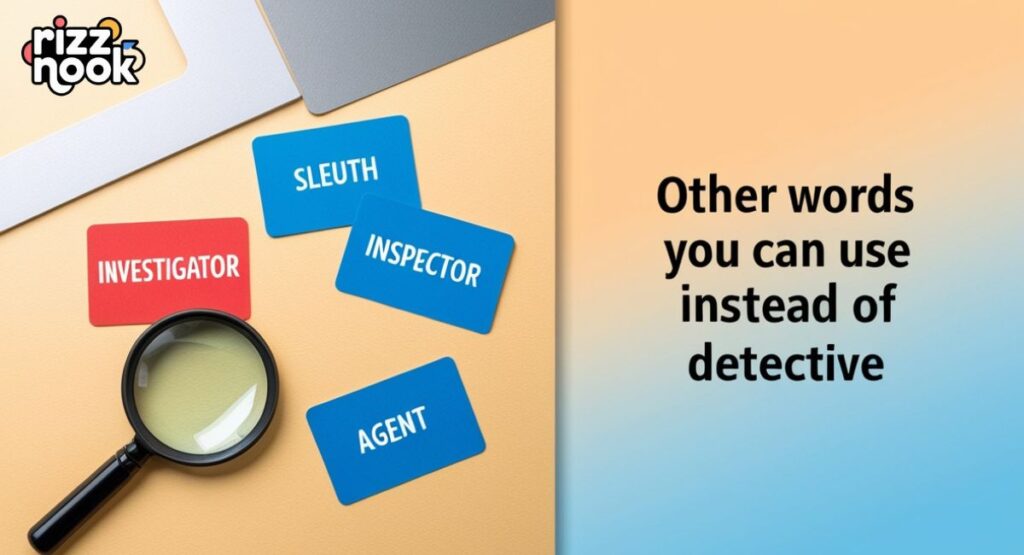
Based on the situation, various synonyms work in place of “detective”:
- Investigator
- Private Eye
- Sleuth
- Inspector (widely recognized in British English)
- Gumshoe (informal, somewhat dated term)
When and How to Use Detective Abbreviations Correctly
In Law Enforcement and Official Writing
In professional and formal settings, shortened forms like “Det.” are frequently used to denote an officer’s rank or position, such as Det. Martinez. Across the U.K. and other Commonwealth nations, you’ll often see forms like D/Inspector or D/Sgt in official records and police documentation. These abbreviations streamline communication and paperwork while still respecting the individual’s professional title.
In Literature, Media, and Informal Use
Within novels, films, and TV shows, you’ll commonly find abbreviations such as “Det.” used in character introductions, screenplay notes, or on-screen text. In more relaxed or everyday writing, people might shorten it further to Detec. Or just D to keep things light and conversational. Among fans and in pop culture discussions, playful alternatives like PI or sleuth often replace the official abbreviation altogether.
Sample Sentences Using “Detective” and Its Abbreviation
With the Full Word “Detective”
- The detective inspected every corner of the scene, searching for overlooked evidence.
- Growing up reading thriller books inspired her to pursue a career as a detective.
- Before submitting his findings, the detective spoke with each person who saw what happened.
With the Abbreviation “Det.”
- Det. Johnson took charge of the robbery case from day one.
- The official document noted that Det. Rivera conducted all suspect interrogations.
- After cracking multiple major investigations, Det. Parker earned a well-deserved promotion.
Other Common Police Rank Abbreviations You Should Know
Sgt. (Sergeant)
This rank involves supervisory duties within police departments, and Sgt. serves as its shortened form.
Example: Sgt. Davis organized the team assignments throughout the night shift.
Insp. (Inspector)
Insp. represents Inspector, a senior-level position typically responsible for managing intricate criminal cases.
Example: Insp. Thompson examined all the evidence reports submitted by junior officers.
Capt.. (Captain)
Capt. abbreviates ‘Captain,’ a rank for a commanding officer who manages several teams or departmental sections.
Example: Capt. Ellis spoke to reporters about the ongoing investigation into the incident.
Detective Titles You’ll See in Movies, Games, and Pop Culture
Private Investigator (PI)
A freelance detective who works independently, often hired by individuals rather than employed by police departments.
Example: In noir films, the PI is usually a lone wolf solving cases from a dimly lit office.
Consulting Detective
An expert investigator called in to assist on particularly challenging cases, popularized by Sherlock Holmes.
Example: Video games like “The Sinking City” feature consulting detectives with unique investigative abilities.
Special Agent
Federal investigators working for agencies like the FBI or CIA, commonly seen in crime thrillers and action games.
Example: Special Agent Cooper from “Twin Peaks” became an iconic TV detective character.
Police Detective
The traditional rank within city police forces is often portrayed as street-smart investigators balancing paperwork and fieldwork.
Example: Detective shows like “Brooklyn Nine-Nine” showcase the everyday life of police detectives with humor and heart.
Occult Detective
A supernatural investigator who solves mysteries involving paranormal phenomena, ghosts, or dark magic.
Example: John Constantine and Geralt of Rivia both function as occult detectives in their respective universes.
Frequently Asked Questions
What is the abbreviation for detective?
The most common abbreviation for detective is “Det.” used in police reports, books, and crime shows.
What does Det. stand for?
Det. stands for Detective, a title used for investigators in law enforcement.
What is the British abbreviation for detective?
In the UK, detective titles often use forms like “DC” for Detective Constable or “D/Sgt” for Detective Sergeant.
How do you write detective in short form?
You can write detective as “Det.” It’s the most widely recognized shorthand.
What is the abbreviation for Detective Sergeant?
The abbreviation for Detective Sergeant is “D/Sgt” in British and Commonwealth police forces.
Is Det. used in American police?
Yes, Det. is commonly used in American police departments to refer to detectives.
What abbreviation is used in crime novels for detective?
Crime novels mostly use “Det.” because it’s short and easily recognizable.
Conclusion
Understanding the abbreviation for detective gives you a clearer picture of how law enforcement language, tradition, and regional practices blend together. From the familiar Det. to rank-based forms like D/Sgt, each version carries its own history and purpose.
Knowing these variations helps you read crime fiction more accurately, interpret reports with ease, and bring authenticity to your own writing. Now that you know what these abbreviations mean and where they come from, try spotting them in your next book, movie, or article. You’ll be surprised how often they appear once you start paying attention.
Read Next: WTM Meaning: What Does “WTM” Mean in Texting?

Welcome to Rizz Nook! I am Kairo, an AI-powered SEO and Content writer with 4 years of experience. I help websites rank higher, drive more traffic, and look great. My goal is to make SEO and web design simple and effective for everyone. Let’s achieve more together.